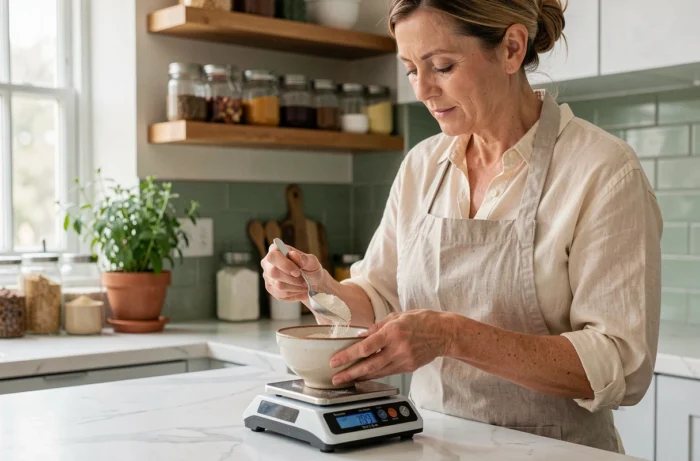
Converting grams to milliliters or estimating the weight of a tablespoon of flour does not involve applying a single formula. Each ingredient has its own density, and it is this data that determines the relationship between mass and volume. Understanding this principle avoids most dosage errors in a recipe.
Ingredient Density: The Trap That Conversion Tables Hide
The rule “1 ml = 1 g” works for water, and only for water. Applying this shortcut to honey, oil, or flour significantly skews the proportions.
Honey, denser than water, weighs considerably more at equal volume. Conversely, oil is lighter: a measuring cup filled with oil weighs less than the same cup filled with water. For flour, the difference is even more pronounced because the powder traps air between its particles.
The same volume can correspond to very different masses depending on the ingredient. A tablespoon of sugar does not weigh the same as a tablespoon of cocoa. Tables that display a single value per container (“1 tablespoon = 15 g”) oversimplify. This figure corresponds to the volume in milliliters, not the actual weight of what the spoon contains.
For baking recipes, where precision matters, it is better to consult a cooking guide from Double Portion that details the equivalences by ingredient rather than relying on a generic table.
Tablespoon and Teaspoon: Actual Volumes in Cooking
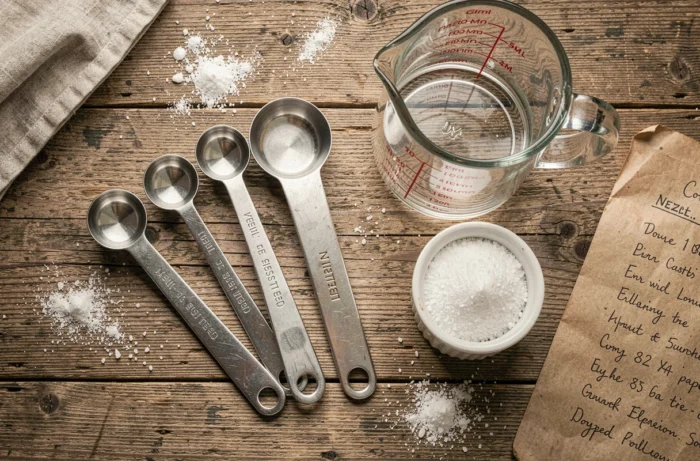
A tablespoon is approximately 15 ml and a teaspoon is approximately 5 ml. These volume markers remain stable. What changes is the mass of the ingredient they contain.
Here are the most useful equivalences, drawn from reference sources:
- Flour: one tablespoon weighs about 15 g, one teaspoon about 5 g, one cup about 150 g
- Sugar: one tablespoon weighs about 15 g, one teaspoon about 5 g, one cup about 200 g
- Ground spices (cumin, paprika, cinnamon): one tablespoon weighs about 8 g, one teaspoon about 3 g
The difference between flour and sugar in a cup (150 g versus 200 g) illustrates the density problem well. Replacing one with the other without adjusting the quantities changes the texture of the result.
Another often overlooked factor: the way the spoon is filled changes the weight obtained. A level spoon, a heaped spoon, and a packed spoon do not yield the same mass. Some recent converters even offer distinct values based on the fill level, which better reflects reality in home cooking.
US Cup, Metric Cup, and Tablespoon: Beware of the Measurement System
Anglo-Saxon recipes use the cup as a unit of volume. The problem is that there are several versions of it.
A US cup is approximately 236.6 ml, while a metric cup (used in Australia, for example) corresponds to 250 ml. The difference may seem small, but in a recipe that calls for three cups of flour, the cumulative difference is enough to alter the result.
The same discrepancy exists for spoons: a US tablespoon measures about 14.8 ml, compared to 15 ml for the metric tablespoon. For a single measurement, the difference is negligible. Over ten tablespoons in a recipe, it becomes noticeable.
Checking whether the recipe uses the US or metric system before converting avoids this type of error. American, British, and Australian cooking sites and books do not use the same standards, even when they employ the same vocabulary.
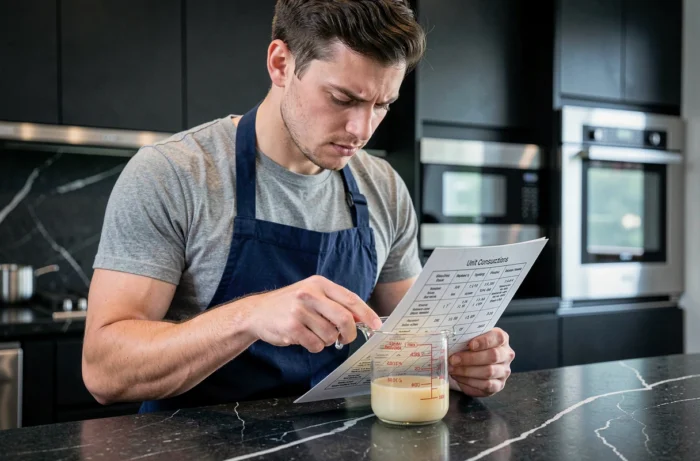
Converting Without a Scale: Everyday Utensils as Reference Points
In the absence of a scale, several common containers serve as reliable volumetric references, provided you know their capacity.
- A standard mustard glass holds about 200 ml
- A medium bowl corresponds to about 250 ml
- A classic yogurt pot represents about 125 ml
These references work well for liquids (water, milk, oil), whose volume is easy to evaluate visually. For powders and solids, the margin of error increases because packing varies from person to person.
The most reliable method remains weighing dry ingredients with a kitchen scale. For liquids, a graduated measuring cup provides sufficiently precise results. Measuring spoons are a good compromise for small quantities (spices, yeast, salt).
A Reflex to Adopt Before Each Conversion
Before converting a measurement, three questions help avoid most errors: Is the ingredient liquid, powdery, or viscous? Does the recipe use US or metric cups? Is the requested spoon level or heaped?
Answering these three questions guides you to the correct conversion value and prevents you from mechanically applying a standard table that does not take into account either the density or the measurement system used. Precision in cooking relies less on memorizing numbers than on understanding the link between mass, volume, and the nature of the ingredient.