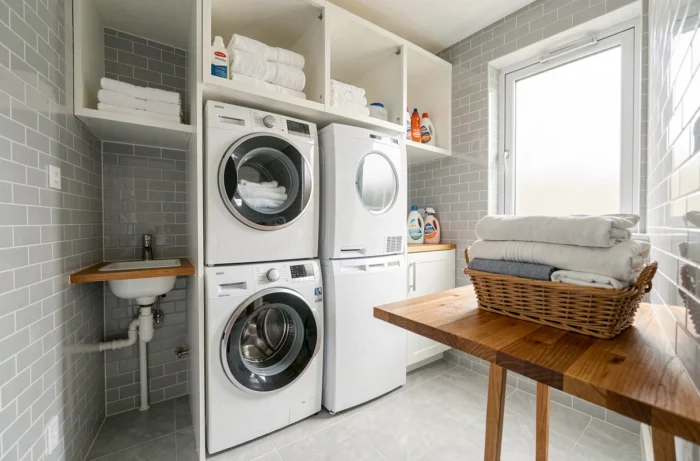
A laundry room and a laundromat refer to two distinct things that are often confused. The first is a private room in a home, while the second is a self-service facility open to the public. Comparing the two means weighing a permanent household space against an occasional, pay-per-use service. This article looks at the practical differences between the two options to determine which best meets a household’s needs.
Home laundry room vs. self-service laundromat: comparison table
| Criteria | Laundry room (at home) | Self-service laundromat |
|---|---|---|
| Type | Private space within the home | Self-service business |
| Access | Available at all times | Limited to opening hours |
| Machine capacity | Generally 6 to 8 kg per cycle | Commercial drums with capacities of up to 18 to 20 kg |
| Cost per cycle | Water, electricity, detergent (included in household bills) | Pay per use (detergent sometimes included) |
| Initial investment | Purchase of a washing machine and possibly a dryer, plus hookups | No equipment investment |
| Maintenance and breakdowns | Responsibility of the appliance owner | Handled by the laundromat operator |
| Drying | Drying rack or dryer, if space allows | Commercial dryers available on-site |
| Bulky textiles | Limited by the size of the household machine’s drum | Suitable for duvets, curtains, and rugs |
This table highlights a fundamental difference: a laundry room offers convenience, while a laundromat offers capacity. The right choice depends on the volume of laundry, the space available at home, and how much money you are willing to tie up in equipment.
To learn more about what a laundry room and a laundromat are, it helps to first recognize that these terms describe complementary uses more than competing options.
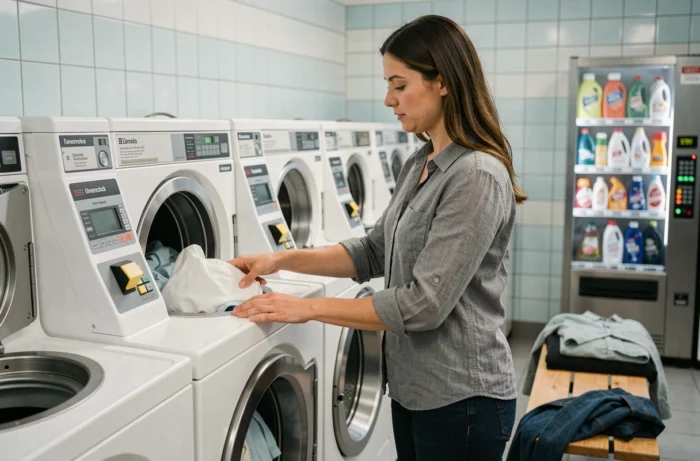
Space at home: the deciding factor
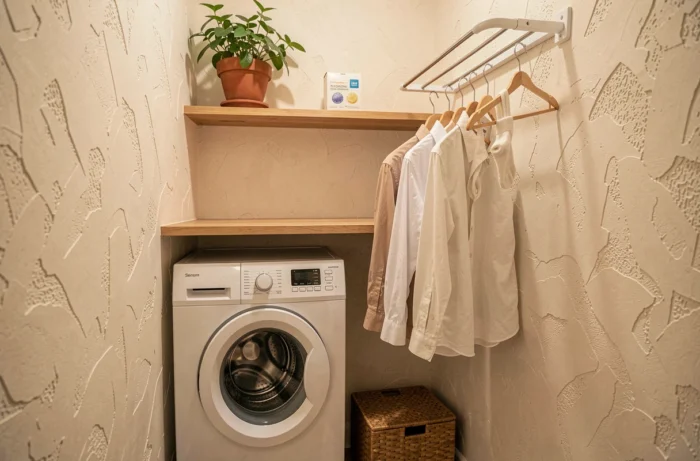
Setting up a laundry room means dedicating a room—or at least a utility nook—to a washing machine, dryer, ironing board, and storage for cleaning products. In a small apartment, that space simply may not exist.
A home with a pantry, garage, or utility kitchen can accommodate the entire laundry setup without encroaching on living space. Without a dedicated area, a laundry room remains a theoretical project.
A laundromat solves this problem by outsourcing the washing. Laundry leaves the home, freeing up space, and comes back clean. The trade-off is the trip: you have to transport the laundry, wait on-site, or return to collect it once the cycle is finished.
Laundromat locations and practical accessibility
Laundromats are no longer limited to city-center locations. Kiosks are now appearing in supermarket parking lots, changing the way people think about convenience. A drive to do the weekly shopping can include a wash cycle without an extra detour.
This setup is a game changer for suburban households that have neither a neighborhood laundromat nor enough room for a full laundry room.
The true cost of doing laundry at home vs. at a laundromat
Washing at home seems cheaper per cycle because household expenses (water, electricity, detergent) are bundled into the overall bills. Calculating the true cost means adding up several expenses that are often overlooked:
- The purchase price of the washing machine and, if applicable, the dryer, spread over their useful life
- Repairs and replacement parts (pump, seal, heating element), paid for by the owner
- Water and electricity consumption per cycle, which varies depending on the selected program and the machine’s age
- Detergent, fabric softener, and descaler
At a laundromat, the price per cycle includes water, energy, and often detergent. There is no upfront investment and no risk of breakdowns. Costs are predictable, but add up with every visit.
For a household that does several loads a week, a home washing machine is generally more economical over time. For a single person or couple who do little laundry, a laundromat avoids tying up several hundred euros in an underused appliance.
Washing capacity and fabric types: where laundromats have the edge
Household machines struggle with bulky textiles. A two-person duvet crammed into a 7 kg drum cannot move around properly: the laundry may come out poorly rinsed and sometimes still damp in the middle.
Commercial laundromat drums can handle 18 or 20 kg. This capacity makes it possible to wash duvets, blankets, thick curtains, and rugs in a single cycle, with enough room to tumble for an even result.
The Eco program cannot make up for a drum that is too small
Modern washing machines offer Eco programs that reduce water and energy consumption. These settings extend the cycle time but do not increase the drum’s capacity. An Eco program on a 7 kg machine is still unsuitable for a large duvet.
Drum capacity remains the limiting factor, not the selected program. This is precisely where the complementary roles of a home laundry room and a laundromat make sense: everyday laundry is washed at home, while bulky items go to the laundromat.
Choosing between a laundry room and a laundromat based on your household
Three factors determine the choice:
- Weekly laundry volume: once you exceed four to five loads a week, home equipment quickly pays for itself
- Available space: without a dedicated room or utility nook with a water connection, a laundry room is not a viable option
- How often you wash bulky textiles: if duvets and curtains need washing several times a year, a laundromat remains the logical complement
Most households with a laundry room also use a laundromat from time to time. The two options are not mutually exclusive. A laundry room takes care of everyday needs, while a laundromat handles loads that a household machine cannot accommodate. The deciding factor is the size of the home: it determines whether a permanent laundry area can be installed.