When searching for “the largest farm in France,” you come across cereal farms of over 2,000 hectares, urban vertical farms, and even an event fair in Vendée. The title circulates, but the measurement criteria change depending on the articles. Exploited area, land ownership grouped under a holding, large-scale livestock activity: each angle designates a different “champion.”
Understanding this ambiguity allows for a more accurate reading of these rankings.
Exploited area, land ownership, or livestock: three criteria, three “largest farms”
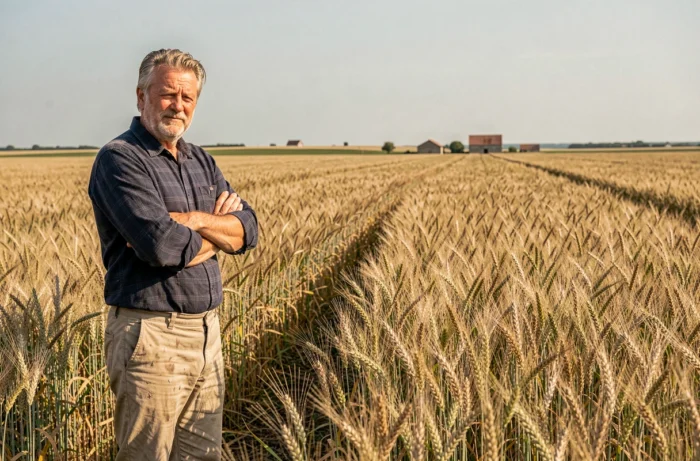
On the ground, when talking about the largest farm in France in hectares, one primarily thinks of the useful agricultural area (UAA). This is the most common criterion in agricultural press. A cereal farm that spans several thousand hectares of large crops in the plains easily wins on this front.
The problem is that the UAA does not always reflect the legal reality. Some structures group dozens of companies (EARL, SCEA, GFA) under a single holding. Each entity holds a few hundred hectares, but together they operate as a single production tool. One can then speak of consolidated land ownership, which inflates the total figure without it being a “farm” in the classic sense.
Livestock further complicates the picture. A dairy or beef operation with a massive herd can claim the title based on the number of heads, even if its area remains modest compared to cereal giants. When searching for the largest farm in France in hectares, it is often noted that articles mix these dimensions without specifying which one underpins their ranking.
The giant farm in Vienne: a concrete case illustrating the holding model
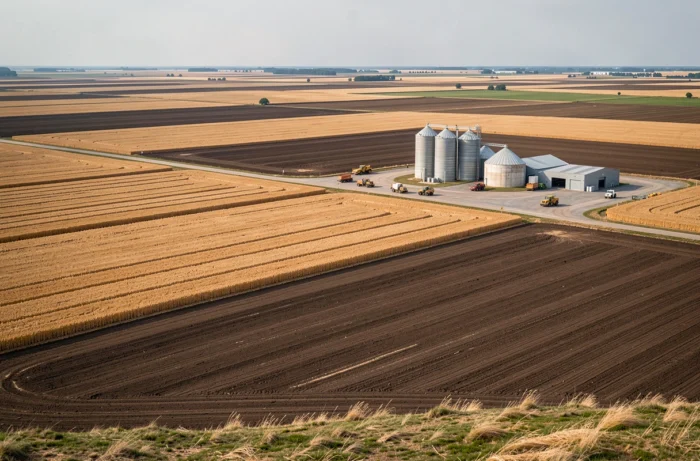
One of the most documented examples is located in Vienne, north and west of Poitiers. This operation spans 2,121 hectares, spread across about ten municipalities. Its plots do not form a compact block but a dispersed network, which is typical of very large structures in large crops.
Twelve companies make up this operation, gathered within a holding. There is also an employer group with more than eleven full-time equivalents, a Cuma to pool equipment, a GIE to market the harvests, and shares in a methanizer. All of this has been put up for sale through Safer Nouvelle-Aquitaine with a starting price of 10.38 million euros.
This legal setup poses a concrete question for potential buyers. The sale was offered as a single lot described as “indivisible.” At least three candidates have come forward, including a coalition supported by the Confédération paysanne, which favors breaking up the operation to install several farmers on smaller areas.
Why Safer intervenes in these transactions
The Société d’aménagement foncier et d’établissement rural (Safer) plays a regulatory role in the agricultural land market. When an operation of this size changes hands, Safer ensures the transparency of the process by publishing an open call for applications. Its intervention allows for the confrontation of installation, takeover, or restructuring projects, rather than letting the transaction conclude privately.
In the case of Vienne, going through Safer made the real size of the operation public, which many were unaware of in the department. The concentration of land behind corporate setups often remains invisible, even to the direct neighbors of the plots.
Vertical farm, Vendée fair: when the title refers to something else
The word “farm” also encompasses realities very different from open-field agriculture. In Château-Thierry, in Aisne, there is what is presented as the largest vertical farm in France. This type of installation produces plants in a closed environment, on several floors, without soil or natural light. The ground area is small, but the cumulative growing area can be significant.
The economic and technical model has nothing to do with a cereal farm. One compares square meters of indoor growing platforms to hectares of land in the plains, making any common ranking absurd.
In Vendée, “the largest farm in France” refers to an event: an agricultural fair organized by the department, which brings together breeders and visitors at a temporary site. The assessment is measured in attendance and local economic impact, not in hectares. Three uses of the same title, three distinct objects.
Criteria to check before comparing
To assess the size of a French agricultural operation without falling into shortcuts, one can rely on several complementary indicators:
- The UAA declared to the CAP: this is the useful agricultural area that the operator declares to receive European aid, making it the most standardized data
- The number of attached legal structures: a holding can aggregate several companies, making the total area harder to identify in public records
- The consolidated turnover and number of employees, which better reflect operational scale than a simple count of hectares
- The type of production (cereals, livestock, market gardening, viticulture), as the land requirements vary radically from one sector to another
Agricultural land concentration in France: what the size question reveals
Behind the curiosity about the largest farm in France lies a deeper issue: the concentration of agricultural land has been accelerating for several decades. The number of farms is decreasing while the average area per farm is increasing. This movement is driven by retirements without successors, mechanization, and economies of scale in large crops.
Corporate setups complicate tracking this concentration. An operation can grow by creating new companies rather than buying land in its own name, which partly escapes traditional statistical tools. Safer and agricultural chambers are trying to map these groupings, but transparency remains limited on very large structures.
The debate surrounding the farm in Vienne illustrates this tension well. On one hand, maintaining an operation of over 2,000 hectares as a single block preserves the production tool and existing jobs. On the other hand, breaking up the operation would allow for several farmers to be installed on more traditionally sized farms, in a department where candidates for installation struggle to find land.
The answer to “what is the largest farm in France” therefore depends as much on the chosen criterion as on the political project one has for agriculture. A figure in hectares tells only part of the story.