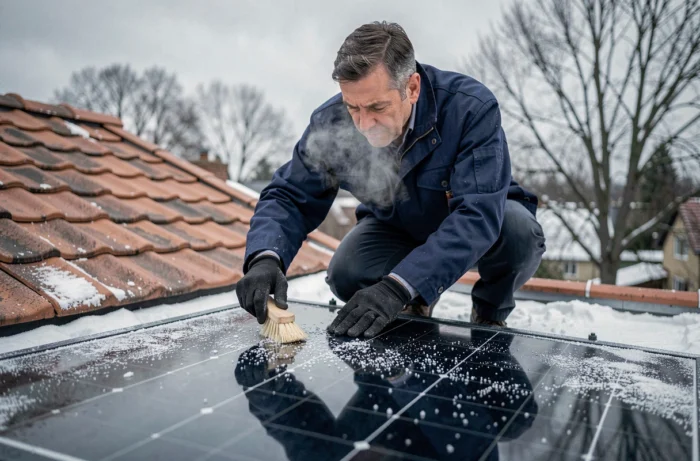
Between November and February, a solar thermal panel continues to capture solar energy to produce heat. The question is not whether it works in winter, but how to measure the performance gap compared to the most favorable months and identify the technical levers that can reduce this gap. Several parameters, often overlooked, directly influence the amount of recoverable heat by the heat transfer fluid circuit during the cold season.
Technical factors that reduce solar thermal production in winter
The drop in winter performance cannot be explained by a single factor. Several elements act simultaneously, and their respective weight varies according to geographical location, type of collector, and the state of the installation.
| Factor | Mechanism | Impact on performance |
|---|---|---|
| Reduced sunlight duration | Shorter days, fewer hours of capture | Direct decrease in the volume of heat produced |
| Low solar angle | Shallow rays, lower energy per m² | Less effective capture if the tilt is not appropriate |
| Increased cloudiness | Frequent cloud cover | Reduction of direct irradiation, capture of diffuse radiation only |
| Thermal losses from the circuit | High temperature difference between collector and outside air | Heat losses on pipes and the storage tank |
| Snow or frost on collectors | Partial or total obstruction of the glazed surface | No production until the surface is cleared |
This table shows that sunlight duration and solar angle are the two structural parameters. The other three, however, relate to maintenance or adjustment of the installation. It is on these last ones that winter optimization produces the most tangible effects.
Analyzing the performance of a solar thermal panel in winter requires distinguishing these structural causes from correctable causes, lest one considers the seasonal drop as a fatality.
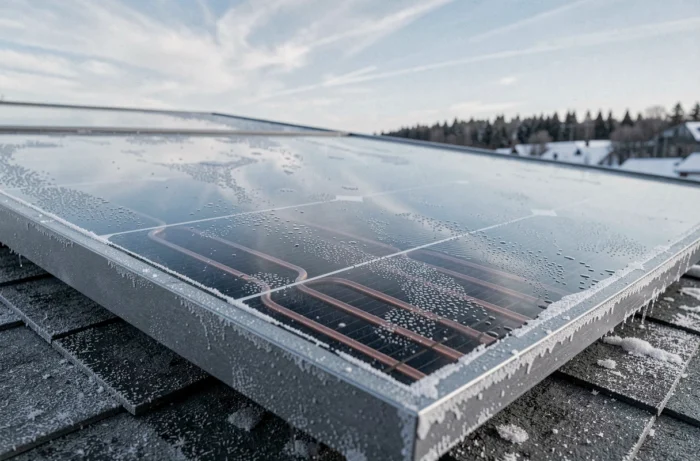
Heat transfer circuit and antifreeze fluid: the adjustment that most installations neglect
The heat transfer fluid (usually a water-glycol mixture) is the heat vector between the collectors and the storage tank. In winter, its role becomes critical for two opposing reasons: it must protect the circuit against freezing while maintaining good thermal transfer capacity.
Glycol concentration and viscosity
An overdose of glycol degrades heat transfer in the circuit. The mixture becomes more viscous, circulates less well, and transfers less energy to the tank. The concentration must correspond to the manufacturer’s specifications and the actual freeze risk of the site, not to an arbitrary safety margin.
Before winter, checking the circuit pressure and the condition of the fluid allows for the detection of a leak, the presence of air, or a chemical degradation of the glycol. These anomalies cause a measurable drop in performance without visible signs on the collectors themselves.
Circuit pressure and purging
Insufficient pressure often indicates a slow leak or a filling defect. Air trapped in the circuit creates pockets that block the circulation of the fluid. Purging is part of the maintenance operations to be carried out before the cold season, and its effect on production can be surprising in its magnitude.
Adjustment of the backup and solar priority: a frequent conflict
Most solar thermal installations are coupled with a backup system (boiler, electric heater, heat pump). This coupling poses a regulation problem in winter: if the backup heats the tank too early, it reduces the solar storage capacity.
The mechanism is simple. The buffer tank has a finite capacity. If the backup heats it in the morning to meet an immediate need, the tank reaches its set temperature before the solar collectors produce their peak heat in the middle of the day. Solar then has no available storage volume.
- Schedule the backup for the end of the day or evening, to prioritize solar during sunlight hours
- Lower the set temperature of the backup by a few degrees to allow for a storage margin
- Check that the temperature sensor of the tank is correctly positioned: a poorly placed sensor can trigger the backup prematurely
This adjustment costs nothing and requires no intervention on the collectors. It only affects the regulation logic of the system.
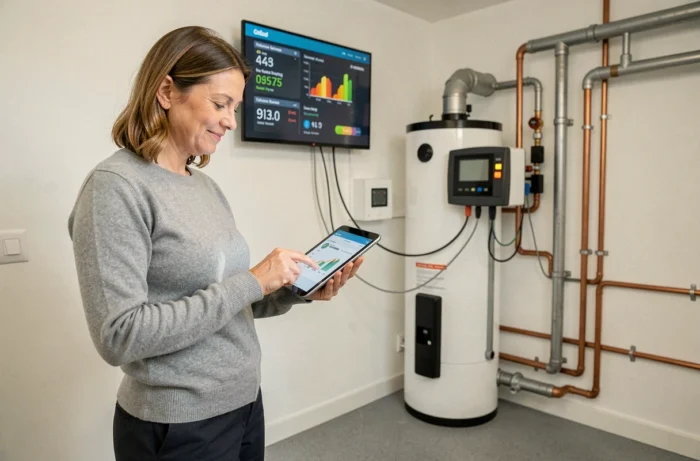
Insulation of pipes and tilt of collectors: two complementary levers
The temperature difference between the hot fluid leaving the collectors and the outside winter air accentuates thermal losses on the pipes. Degraded insulation on a few meters of outdoor piping can dissipate a significant portion of the captured heat.
Insulating jackets exposed to the elements deteriorate over time (UV, humidity, rodents). Visual inspection of the pipes between collectors and tank is part of the pre-winter check, just like checking the fluid.
Adjusting the tilt for the low winter sun
In winter, the sun remains low on the horizon. A collector tilted for average annual performance (around the latitude of the location) does not adequately capture the shallow rays of December or January. Increasing the tilt by a few degrees in winter improves capture when the system allows it.
Some installations have adjustable supports. For fixed roofs, the tilt is a compromise defined at installation. In this case, optimization relies more on the other levers (fluid, regulation, insulation).
Seasonal shading and maintenance of the glazed surface
A deciduous tree that does not obstruct the collectors in summer can cast a shadow on the glazed surface in winter when the sun is lower. This seasonal obstruction is easy to spot but rarely anticipated during installation.
- Observe the shadows cast on the collectors between 10 a.m. and 2 p.m. during winter
- Trim branches that intercept direct radiation
- Clear snow from the collectors as soon as the layer is thick enough to block light, using a non-abrasive tool
- Clean the glass of the collectors to remove deposits (leaves, dust, moss) that reduce light transmission
These maintenance actions do not require any particular technical skills. They fall under regular maintenance, but their cumulative impact on winter production is often underestimated.
The performance of a solar thermal panel in winter depends less on the weather than on the actual condition of the heat transfer circuit, the regulation adjustment, and the insulation of the pipes. The structural causes (reduced sunlight, low solar angle) do not change. The correctable causes, however, represent the concrete margin for maneuver to maintain useful heat production between November and February.