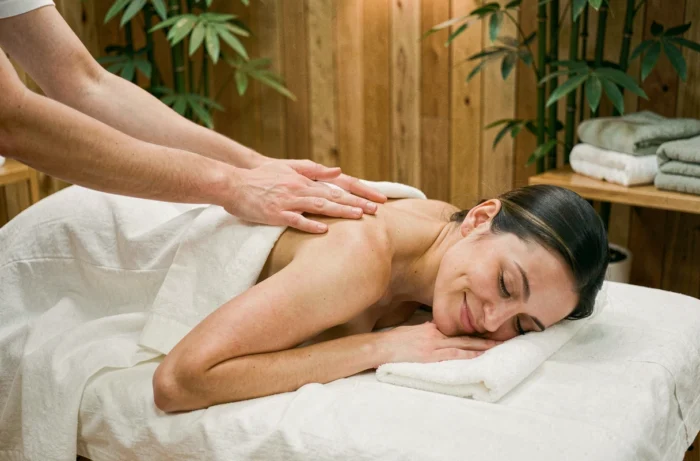
Wellness massage refers to a set of manual techniques applied to the body’s soft tissues with the aim of relaxation, without therapeutic or rehabilitative intent. Its action is based on precise physiological mechanisms, notably the modulation of the autonomic nervous system and the reduction of cortisol production by the adrenal glands. Understanding these mechanisms allows us to distinguish between subjective feelings and measurable responses from the body.
Autonomic nervous system and massage: the central mechanism of relaxation
The human body manages stress through two branches of the autonomic nervous system: the sympathetic, which accelerates heart rate and mobilizes energy in alert situations, and the parasympathetic, which slows these reactions and promotes recovery.
During a massage, slow and repeated pressure on the skin activates cutaneous mechanoreceptors. These receptors send signals to the brainstem, which in turn stimulates the vagus nerve, the main vector of the parasympathetic system. Heart rate slows, breathing deepens, and blood pressure decreases.
This shift towards the parasympathetic is not limited to the duration of the session. The parasympathetic effect can last several hours after the massage ends, which explains the often reported lasting sense of calm. This response is not mysterious: it stems from a well-documented neurovegetative reflex arc.
To explore the wellness offered by Les Massages De Tiphaine, this parasympathetic logic forms the foundation of each session, tailored to the individual’s tension level.
Cortisol and endorphins: what massage changes in stress chemistry
Cortisol is a hormone produced by the adrenal glands in response to stress. In acute doses, it helps the body react. When its production remains high over long periods, it disrupts sleep, weakens immune defenses, and promotes the accumulation of chronic muscle tension.
Massage techniques act on two complementary hormonal levers. On one hand, parasympathetic stimulation reduces the command for cortisol production. On the other hand, deep pressure on the muscles triggers the release of endorphins, neuropeptides with natural analgesic properties.
This dual effect, lowering cortisol and increasing endorphins, explains why a massage can tangibly alter mood. The relaxation felt is not just an impression: it corresponds to a measurable change in hormonal balance.
The impact on sleep
A high cortisol level at the end of the day delays falling asleep and fragments sleep cycles. By lowering this level, massage facilitates the transition to deep slow-wave sleep, the most restorative phase.
A massage at the end of the day directly affects the quality of nighttime sleep. This sequence is more effective than the same massage performed in the morning, as it coincides with the natural decline in cortisol.
Chronic muscle tension: why stress lodges in the body
Prolonged stress maintains a low-intensity muscle contraction, often localized in the trapezius, neck, and lower back. This permanent contraction, known as defensive muscle tone, eventually creates areas of stiffness and pain that perpetuate themselves.
The cycle is simple: stress contracts the muscles, muscle pain generates additional stress, and the contraction worsens. Massage interrupts this cycle by acting on two simultaneous levels.
- At the peripheral level, kneading and friction techniques increase local blood circulation, which accelerates the elimination of metabolites accumulated in contracted muscle fibers.
- At the central level, stimulation of mechanoreceptors sends an inhibition signal to the motor neuron, reducing involuntary muscle tone.
- At the fascial level, sustained pressure on connective sheaths restores some of their elasticity, limiting the sensation of joint blockage.
This triple mechanism explains why a regular session is better at preventing tension than a single session is at correcting it. Regularity helps maintain a lower baseline muscle tone.

Wellness massage and practice framework: what to check before a session
In France, wellness massage is distinguished from therapeutic massage by its purpose. A wellness practitioner does not treat a pathology and does not make a diagnosis. This distinction has concrete consequences on the choice of professional and on reasonable expectations regarding a session.
Certifications and training
Wellness massage does not require a state diploma, unlike massage therapy practiced by physiotherapists. Certifications registered in the RNCP (National Directory of Professional Certifications) serve as an indicator of seriousness, although they are not mandatory. Checking the practitioner’s training before booking remains a useful precaution.
Situations to postpone the session
A preliminary interview with the practitioner helps identify cases where the massage should be adapted or postponed:
- Fever, ongoing infection, or open wound in the area to be massaged.
- New and unexplained pain, which requires medical advice first.
- Recent trauma (sprain, fracture), where pressure could worsen the injury.
- Certain vascular or inflammatory conditions, which require reduced pressure or a specific technique.
A trained practitioner adapts pressure, position, and duration based on what this exchange reveals. Wellness massage complements a healthy lifestyle; it does not replace medical follow-up when pain persists or a symptom is concerning.
Incorporating a massage session into a weekly or biweekly routine has a cumulative effect on the nervous system, hormonal balance, and muscle tone. The most underestimated benefit is probably this regularity: a body that periodically returns to a deep parasympathetic state manages daily stress peaks with a wider recovery margin.