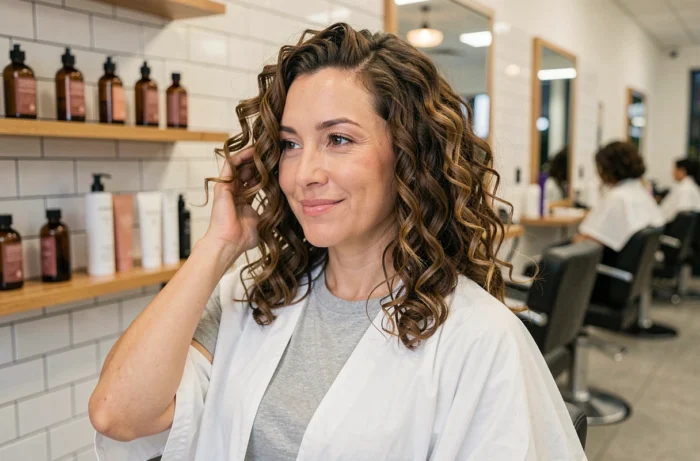
The “ammonia-free” labeled perm formulas suggest that the process is harmless. The reality is more nuanced: removing ammonia from a formulation does not eliminate the chemical action on keratin, nor the risk of skin sensitization. Comparing active agents, their regulatory framework, and their actual impact on hair fiber allows us to distinguish the alternatives that effectively protect the hair from those that merely replace one irritant with another.
Ammonia-free perm and alternatives: what the formulas really contain
| Type of formula | Main active agent | pH level | Action on the fiber | Prior skin test |
|---|---|---|---|---|
| Classic perm (ammonia) | Ammonium thioglycolate | Alkaline (high) | Breakage and then reformation of disulfide bonds | Recommended |
| “Ammonia-free” perm | Thioglycolate with another alkaline base (MEA, AMP) | Alkaline (moderate to high) | Same mechanism, reduced odor | Recommended |
| Acid perm / glycerol monothioglycolate | Glycerol monothioglycolate | Acid (lower) | Softer restructuring, looser curl | Recommended |
| Techniques without chemical agents (braids, curlers, plopping) | None | Not applicable | Temporary deformation by mechanical tension | Not necessary |
The table highlights a point often overlooked: removing ammonia does not eliminate thioglycolate. The reducing agent remains the same in the majority of so-called “gentle” kits. Only the alkaline base changes, which reduces the odor but not necessarily the aggression on the fiber.
To delve deeper into the composition of these products, hair care on Miss Marion details the chemical mechanisms of each type of perm and their effects on hair.
Thioglycolate and pH: the two parameters that determine the safety of a perm
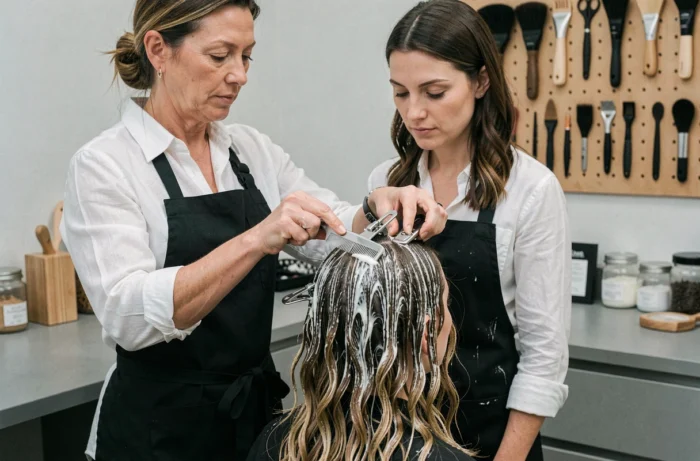
The concentration of thioglycolate and the pH of the finished product are the two variables that condition the degree of transformation of keratin. An alkaline pH opens the hair cuticles, facilitating the penetration of the reducing agent. The higher the pH, the faster the restructuring, but the greater the risk of breakage.
An acid formula restructures the fiber without opening the cuticles as much. Glycerol monothioglycolate, used in so-called acid perms, operates at a lower pH. The resulting curl is generally looser, and the fiber retains more of its natural hydration.
The label “ammonia-free” does not inform about the actual pH
A product can claim “ammonia-free” while still reaching a comparable alkaline pH due to monoethanolamine (MEA) or aminomethyl propanol (AMP). These substitutes serve exactly the same function: swelling the fiber to allow the reducing agent to pass through. The pH of the finished product matters more than the isolated ingredient list.
The European regulatory framework also requires an evaluation of the finished product, not just a simple validation ingredient by ingredient. A cosmetic placed on the market must have a safety report, a product information file, and a CPNP notification, including for formulas presented as natural or ammonia-free.
Skin test before perm: a step that the “gentle” label does not exempt
Professional recommendations advocate for a skin test with the exact product before each perm, regardless of the label on the bottle. The procedure involves applying a small amount of the preparation to the skin (often behind the ear or in the elbow crease) and observing the area for 48 hours before proceeding with the full treatment.
This waiting period is not an excess of caution. A formula devoid of ammonia may still contain preservatives, fragrances, or reducing agents that could provoke a reaction. The colorist or the person performing the perm at home must therefore apply this protocol with each change of batch or brand.
Warning signs to watch for
- Redness, itching, or swelling at the application site within 48 hours of the test: the product is not suitable, even if labeled “gentle” or “ammonia-free”
- Abnormal dryness or roughness on a test strand: the concentration or application time exceeds what the fiber can tolerate
- Persistent odor after rinsing: some ammonia substitutes, like MEA, emit a more discreet odor but remain active alkaline agents
Mechanical alternatives to chemical perms: temporary curls without altering keratin structure
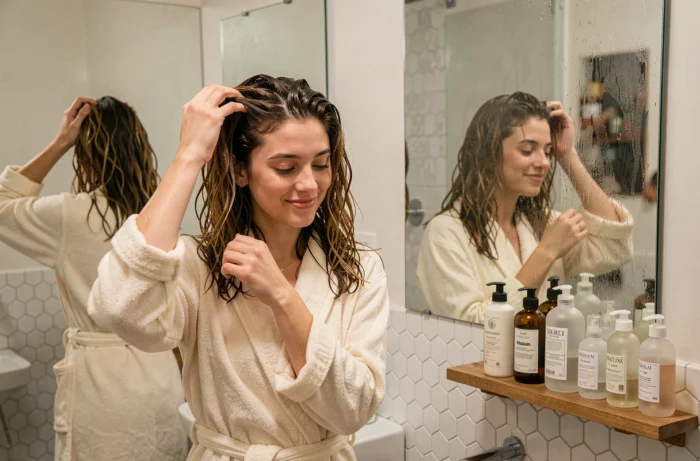
To achieve curls without modifying the internal structure of the hair, several mechanical techniques produce visible results for one to three days depending on hair texture. None break disulfide bonds: the deformation relies solely on tension and drying.
- Braids made on damp hair and then undone after complete drying: the size of the sections determines the amplitude of the wave, with fine braids giving tighter curls
- Flexible curlers or foam rollers placed overnight: they create regular curls without heat, suitable for medium to long hair
- Plopping with a microfiber cloth or a cotton t-shirt: this method is particularly suitable for naturally wavy or curly hair that needs definition rather than restructuring
These techniques do not replace a perm if the goal is a lasting result. Their main advantage is the complete absence of chemical risk, making them compatible with hair already weakened by coloring or repeated treatments.
Combination of care and mechanical techniques
Applying a leave-in treatment before braiding or wrapping the hair improves curl retention and reduces frizz. A well-hydrated hair retains the mechanical shape longer than dry hair, as the supple fiber deforms more uniformly.
The choice between chemical perm and mechanical technique ultimately depends on two criteria: the desired duration of the result and the current state of the hair fiber. Hair already sensitized by repeated coloring does not tolerate an additional reducing treatment well, even if labeled “ammonia-free”. In this case, methods without chemical agents remain the only option that does not further degrade keratin.