The term “thermoplastic floor” encompasses a family of coverings made from polymers (PVC, polypropylene, polyethylene) whose structure softens under the influence of heat and hardens upon cooling. This cycle is reversible, which distinguishes these materials from thermosetting ones. Understanding the characteristics of a thermoplastic floor allows for a choice based on measurable technical criteria, not on marketing promises.
Chemical composition and behavior of thermoplastic material
The majority of thermoplastic floors sold in France are based on polyvinyl chloride (PVC). PVC is prepared from two raw materials: about 57% salt and 43% oil, making it the only commonly used plastic where more than half comes from an abundant mineral resource.
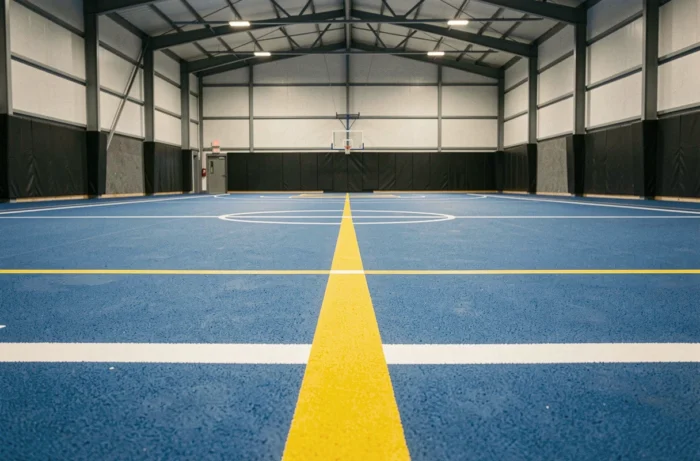
Polypropylene (PP) constitutes the other major family, especially for interlocking tiles intended for sports fields or garages. Both polymers share a central property: thermoplasticity, which is the ability to deform mechanically when heated and then retain that shape upon cooling.
This thermal reversibility has a direct practical consequence. The covering contracts in cold weather and expands under high heat. An insufficient peripheral joint or glued installation on a poorly prepared substrate can cause buckling in summer or visible shrinkage in winter. Field reports vary on the actual extent of these movements depending on the ranges, but the phenomenon is documented by all manufacturers.
Homogeneous or heterogeneous PVC floor: a choice that determines wear resistance
PVC floors are divided into two structural categories that must be distinguished before any price or visual comparison. To delve deeper into this subject, a detailed guide presents the characteristics of a thermoplastic floor according to each product family.
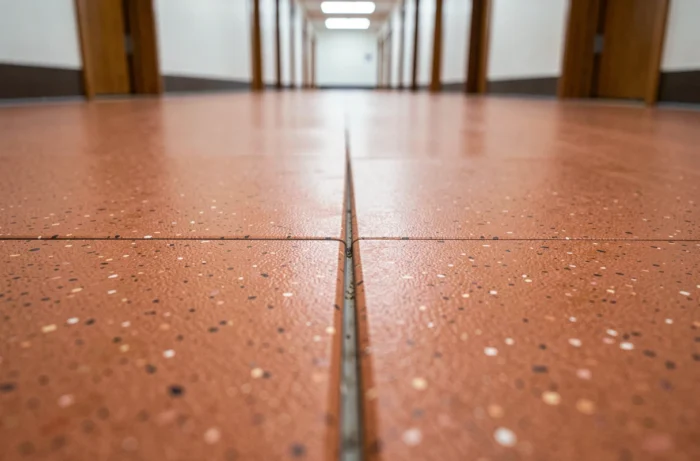
- The homogeneous PVC floor consists of a single layer of identical material throughout its thickness. Surface sanding reveals the same material underneath, allowing for renovations through mechanical stripping. This is the type of covering found in most healthcare facilities.
- The heterogeneous PVC floor overlays several layers (wear layer, decorative layer, support layer). The decoration is printed, and the resistance depends on the thickness of the upper wear layer. Once this layer is pierced, the floor cannot be renovated in the same way.
- Interlocking polypropylene tiles form a third option, primarily aimed at sports or industrial uses. Their perforated structure facilitates water drainage, but their acoustic comfort remains limited compared to flexible PVC.
The UPEC classification, issued by the CSTB (Scientific and Technical Center for Building), evaluates wear resistance (U), puncture resistance (P), water behavior (E), and chemical agents (C). This classification remains the main prescription tool to verify that a thermoplastic floor corresponds to the intended use of a space.
Installation of a thermoplastic covering: the flatness of the support as a decisive factor
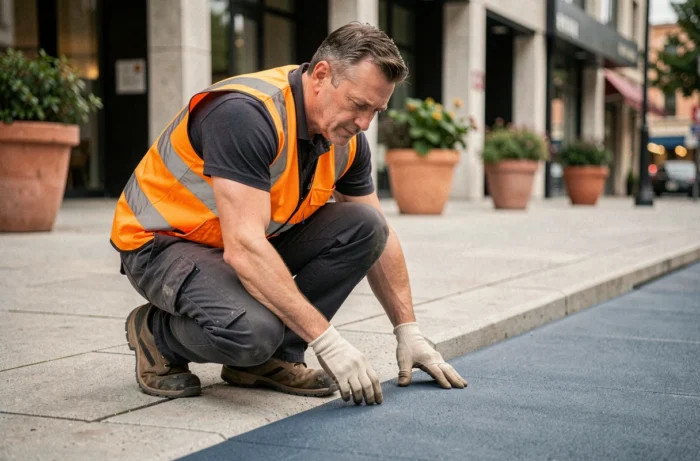
Manufacturers of interlocking tiles emphasize the ease of installation without glue. This is a valid argument for a garage or an outdoor terrace. However, for a flexible PVC floor intended for a hospital corridor or a residence, glued installation on a leveling compound remains the norm.
Recent prescriptions, particularly the ACIP protocol for rigid vinyl floors, recommend a flatness tolerance of around 2 mm per meter on the substrate. Below this threshold, prior leveling (self-leveling compound) is necessary. Ignoring this step generates visible defects after a few months: joint lips, bubbles, localized detachments.
Acclimatizing the covering in the room before installation (generally several hours at room temperature) is also part of standard recommendations. A thermoplastic floor installed too cold will contract after placement and may create gaps between the sheets or tiles.
Cleaning and regular maintenance
A thermoplastic floor is maintained with clear water or a neutral detergent. Aggressive solvents and abrasive products should be excluded: they attack the wear layer and reduce the lifespan of the covering. For homogeneous floors in hospital environments, periodic stripping followed by waxing (or metallization) helps restore shine and surface protection.
The origin of maintenance problems often comes from an overdose of products rather than a lack of cleaning. The accumulation of detergent residues forms a sticky film that traps dirt and dulls the floor.
FDES and RE2020 compliance: an underestimated selection criterion
For projects subject to RE2020, the choice of flooring no longer relies solely on mechanical performance. The existence of a verified FDES in the INIES database conditions the environmental calculation of the building. An FDES (Environmental and Health Declaration Sheet) is based on a life cycle analysis compliant with the NF EN 15804+A2 standard and is subject to third-party verification.
In the absence of a specific FDES for the prescribed product, the regulatory calculation resorts to a default data, often more penalizing for the overall carbon balance of the project. Thus, comparing two thermoplastic floors solely based on their generic family (“PVC” or “vinyl”) is not sufficient: it is the product sheet of the actually installed product that counts.
The available data do not yet allow us to conclude that all manufacturers have submitted their FDES for their entire ranges. The gap between commercial offerings and the coverage of the INIES database remains a point of vigilance for prescribers.
Actual recyclability of thermoplastic floors
Thermoplasticity makes these materials potentially recyclable after grinding, as the material can be remelted without theoretical degradation of its molecular structure. In practice, recycling depends on the purity of the collected stream. A heterogeneous PVC floor containing layers of fiberglass or complex prints is less easily recycled than a homogeneous single-material floor.
Collection channels exist, but their territorial coverage and accessibility vary. Claiming that a thermoplastic floor is “recyclable” without specifying the locally available channel remains insufficient as an environmental argument.
The choice of a thermoplastic floor hinges on verifiable technical parameters: UPEC classification suitable for the intended use, flatness of the substrate before installation, existence of an FDES for regulated projects, and reality of the recycling channel at the end of life. These criteria, rarely highlighted in consumer product sheets, condition the actual durability of the covering much more than its thickness or pattern.