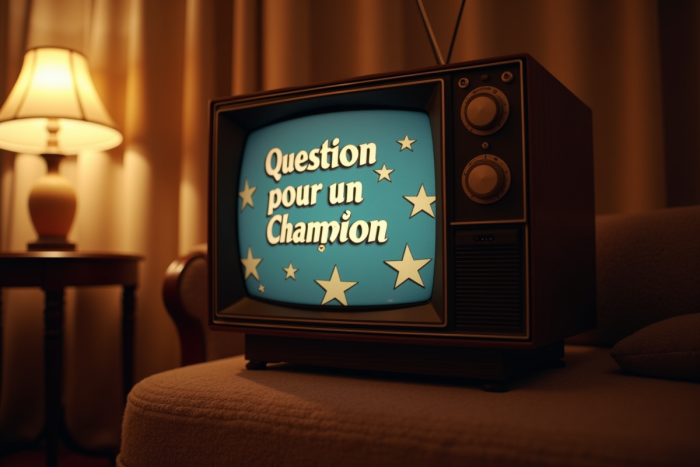
French television shows are filled with striking symbols that have captivated generations of viewers. Among them, the famous throne of ‘Questions pour un champion’, where contestants compete in a studious yet electric atmosphere, has become an unforgettable icon. Just like the mythical ‘doors of success’ from ‘N’oubliez pas les paroles’, where ordinary people reveal their musical talent.
Other symbols, such as the red carpet of ‘Vivement Dimanche’ or the bell from ‘Le Juste Prix’, continue to resonate in the collective imagination. These visual and auditory elements have created a true cultural imprint, making these shows instantly recognizable.
The iconic symbols of entertainment shows
French television has seen the birth of indelible symbols over the decades. Among the most notable, the famous red chair from ‘The Voice’ symbolizes excellence and the ultimate recognition for contestants. This chair, turning with each performance, has become a true visual landmark for music and competition enthusiasts.
The logo of Koh Lanta, representative of adventure and survival, is another example of a powerful symbol. It embodies not only the spirit of self-overcoming but also resilience in the face of natural elements. This logo is an invitation to escape and explore, echoing the aspirations of many viewers.
- The multicolored set of ‘Fort Boyard’, with its mythical challenges and iconic characters, is another strong symbol. This unique decor immediately evokes the idea of challenge and courage.
- The wheel of ‘La Roue de la Fortune’, with its vibrant colors and segments of varied prizes, is another visual element that has left a mark. It embodies luck and suspense, essential ingredients for the show’s success.
The striking symbols of cultural and educational shows
French television is not limited to entertainment. Cultural and educational shows also offer striking symbols. The map of France from ‘Des chiffres et des lettres’, for example, is an educational tool that has allowed generations to learn while having fun.
The blackboard of ‘C’est pas sorcier’, with Fred and Jamy, is another example. This symbol of scientific popularization has made complex knowledge accessible to a wide audience, thus marking the history of French educational television.

The striking symbols of cultural and educational shows
Cultural and educational shows on French television have created symbols just as strong as their entertainment counterparts.
Take ‘La Marseillaise’. This song, composed by Rouget de Lisle in 1792, was declared the national anthem by the Convention on July 14, 1795. Banned under the Empire and the Restoration, it was orchestrated by Berlioz and ultimately declared the national anthem by the Third Republic in 1879. The Fourth Republic incorporated it into the Constitution in 1946, and the Fifth Republic mentions it in its 1958 Constitution. This trajectory shows how a revolutionary song became a national symbol, omnipresent in historical and educational shows.
The blackboard of ‘C’est pas sorcier’, a show embodied by Fred and Jamy, is another example. It symbolizes scientific popularization and playful pedagogy, making complex knowledge accessible to a wide audience. This blackboard has become an iconic tool, representing learning through an interactive and engaging approach.
- The globe of ‘Ushuaïa Nature’, hosted by Nicolas Hulot, symbolizes the commitment to preserving the planet. This globe, omnipresent in the opening credits, embodies the call for ecological awareness and the discovery of natural wonders.
- The set of ‘Secrets d’Histoire’, decorated with ancient books and portraits, represents immersion in the past. This carefully crafted staging invites viewers to explore the intricacies of history with Stéphane Bern.
These symbols, both visual and conceptual, have marked the history of French television, resonating far beyond the screens. Consider these elements as cultural landmarks, witnesses to the evolution of our society and our relationship with knowledge.