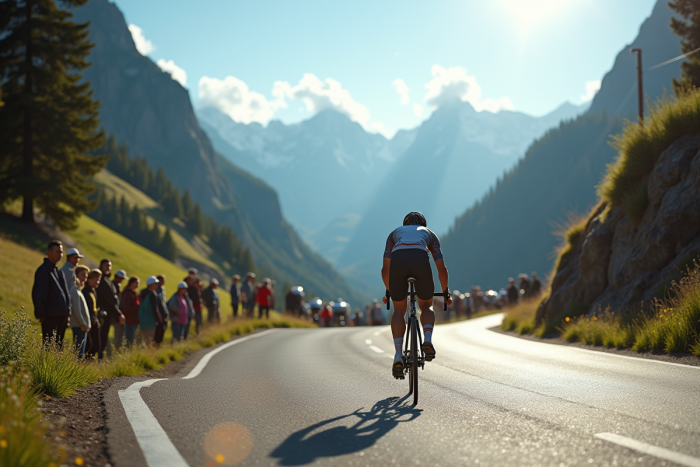
The mountains provide a majestic and unforgiving backdrop for the most memorable feats of cycling. The steep slopes and dizzying passes test the endurance and determination of the riders, turning each ascent into a personal epic. Over the decades, legendary peaks like Alpe d’Huez and Mont Ventoux have been the stage for epic battles, where cyclists have faced off for glory and victory.
Spectators, gathered along the winding roads, resonate with the rhythm of the athletes’ superhuman efforts, creating a unique and intoxicating atmosphere. Each mountain stage thus becomes an unforgettable chapter in the history of cycling, marking minds and engraving names into legend.
The mythical climbs that forged the legend of cycling
Cycling finds its most beautiful pages in the mountains. The legendary passes of the Tour de France like Alpe d’Huez, Mont Ventoux, and Galibier are theaters of exploits where champions reveal themselves. These climbs are not just sporting challenges; they are living myths that haunt the collective imagination.
The five monuments of cycling, although primarily one-day races and some without major climbs, share this heroic dimension. Each of these races, through their history and difficulty, has left a mark on the minds.
- Milan-San Remo (established in 1907, approx. 298 km)
- Paris-Roubaix (established in 1896, approx. 257 km)
- Tour of Flanders (established in 1913, approx. 260 km)
- Liège-Bastogne-Liège (established in 1892, approx. 250 km)
- Tour of Lombardy (established in 1905, approx. 245 km)
Feats in the mountains are not limited to simple ascents. They include moments of bravery like that of Cavendish at Plateau de Beille, inscribing these places into the history of sport. Cyclists like Eddy Merckx, Bernard Hinault, and Fausto Coppi built their legends there. The slopes of Monte Zoncolan, nicknamed ‘the hell of the Dolomites’, and those of Mont Ventoux, often called the ‘Giant of Provence’, remain formidable challenges, symbols of endurance and self-overcoming.
The ascent of these mountains is the terrain where physical endurance meets mental strength, where each pedal stroke is a struggle against oneself, against the slope, against the clock. The mountains of cycling are much more than natural obstacles: they are the arenas where legends are forged.
The unforgettable feats of cyclists in the mountains
The mountains are the stage for performances that forever mark the memory of cycling enthusiasts. Names like Eddy Merckx, Bernard Hinault, and Fausto Coppi still resonate in the mythical passes where they forged their legend. Merckx, nicknamed ‘the Cannibal’, accumulated 19 victories in the five monuments of cycling. Hinault, ‘the Badger’, won 8, and Coppi, ‘Il Campionissimo’, 7.
The mythical passes: Monte Zoncolan and Mont Ventoux
Monte Zoncolan, known as ‘the hell of the Dolomites’, imposes dizzying percentages with a maximum gradient of 22% and an average gradient of 11.9% over 10 km. Its first ascent during the Giro d’Italia in 2003 immediately placed this pass among the most formidable.
On the other hand, Mont Ventoux, rising to 1910 m above sea level, has been a must-visit stage of the Tour de France since its first ascent in 1951. With an average gradient of 7.5% over 20 km, the Giant of Provence demands that cyclists push their physical and mental limits.
Memorable moments of bravery
The feats of cyclists like Merckx, Hinault, and Coppi are not limited to simple victories. They include unforgettable moments of bravery, such as decisive attacks in the high mountains. These performances are etched in the history of sport, symbols of endurance and determination.
The mountains of cycling are much more than natural obstacles: they are the arenas where legends are forged, where each pedal stroke is a struggle against oneself, against the slope, against the clock.