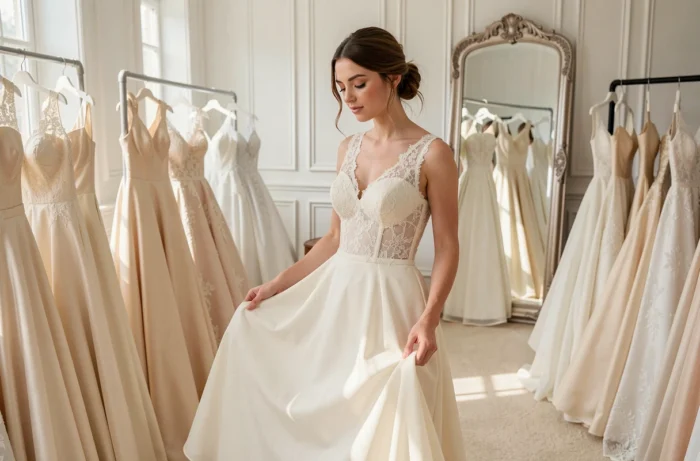
The wedding dress market has significantly evolved in recent years. With the rise of second-hand options, the emergence of transformable models, and an increasing focus on fabric traceability, the criteria for selection are no longer limited to cut or color. Choosing a wedding dress now involves balancing parameters that traditional guides rarely address.
Transformable wedding dresses: an underestimated selection criterion
Most online advice focuses on the silhouette worn on the day of the ceremony. They overlook a question that weighs heavily on the decision: what happens to the dress after the wedding?
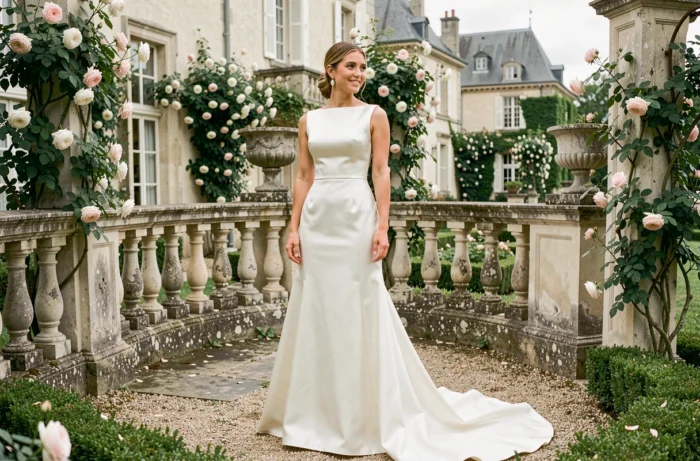
Some workshops design modular dresses with removable elements (over-skirt, detachable train, clip-on sleeves). The benefits are twofold. On the big day, the bride can adapt her outfit between the ceremony and the evening. After the wedding, the piece can be worn again, resized, or resold more easily.
This type of design changes the perspective: instead of searching for the most spectacular dress for a single day, one can incorporate the piece’s durability into the choice. The houses offering this approach remain in the minority, but their offerings are growing, particularly among French designers working in short supply chains. On perlemaisondemariee.fr, several collections illustrate this logic of dresses designed beyond the big day.
Fabric traceability: looking beyond the ‘eco-friendly’ label
The term “eco-friendly” appears on an increasing number of wedding dresses without its meaning always being verifiable. Fabric traceability is, however, a selection criterion in its own right, and feedback varies on this point depending on the workshops.
Several elements help clarify the situation:
- Textile certifications like OEKO-TEX attest to the absence of certain harmful substances in the fabric but do not guarantee the entire production chain.
- Workshops that operate in small series and short supply chains reduce fabric waste and limit transportation, which can be verified by asking about the origin of the materials during fittings.
- Certified fabrics are not synonymous with fragile fabrics: organzas, tulles, and laces can carry these labels while offering a hold comparable to conventional materials.
Asking about the fabric’s origin during the first appointment in the store provides a reliable indication of the seriousness of the approach. A transparent workshop will respond without difficulty. Vague discourse on the subject should be considered a warning sign.
Second-hand and wedding dress rental: what it concretely changes
Second-hand and rental options are no longer fallback solutions reserved for tight budgets. Recent publications present them as conscious choices to access designer models that would otherwise be out of reach at new prices.
However, these options involve checks that a traditional store purchase does not require. The actual condition of the dress (yellowing, fragility of embroidery, cleaning marks) must be inspected in person. Possible alterations vary greatly depending on the construction of the piece: a structured dress with boning is less easily altered than a fluid cut.
For rentals, the return conditions deserve careful reading. Cleaning, return deadlines, and deductibles in case of damage are often underestimated factors. The actual cost of a rental, once these fees are included, can approach that of a new entry-level dress.
When second-hand makes perfect sense
Buying second-hand works particularly well for minimalist dresses, whose style does not go out of fashion from season to season. Highly ornate or voluminous models are more difficult to resell and lose value more quickly.
The ability to reallocate the saved budget towards other wedding expenses (catering, photographer, venue) is the most frequently cited argument by brides who have chosen this route.
In-store fittings: methodological errors that skew the choice
Competing guides often list dress styles by body type. This categorization has its limits: a flattering dress on a mannequin does not produce the same effect depending on the fabric, lighting, and posture.
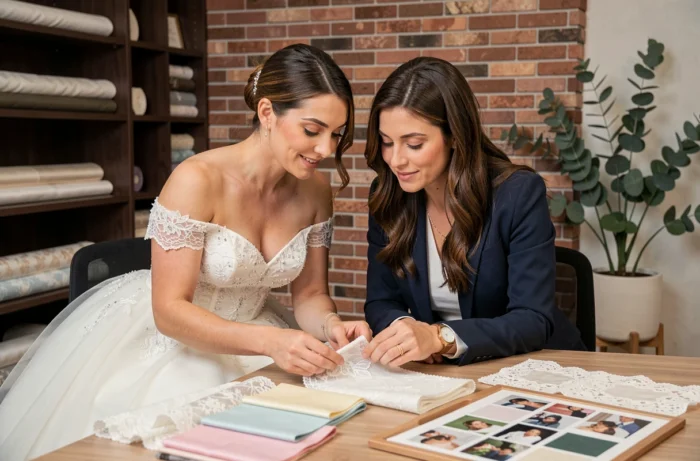
Two methodological errors frequently recur. The first is trying on too many models in one session. Beyond four or five dresses, the ability to compare decreases, and decision fatigue sets in. The second error is coming with too large a group: conflicting opinions muddle personal feelings instead of refining them.
A rarely mentioned point concerns the time of day. Fittings late in the morning or early afternoon generally offer more representative natural light than that of a store artificially lit later in the day. Some stores have a space illuminated by daylight, which is worth asking about when making an appointment.
What to bring to a fitting
- Body-hugging, nude-colored underwear to assess the actual transparency of the fabric.
- Shoes with a heel height that matches that intended for the wedding, as the length of the dress and the balance of the silhouette depend directly on this.
- A photo of the ceremony venue, so the consultant can guide suggestions towards coherence with the setting (outdoor, church, atypical location).
The choice of a wedding dress is best approached as a balancing act between several concrete parameters rather than as a purely emotional quest. Durability of the piece, origin of the materials, conditions of purchase or rental, fitting methods: these filters, combined with the actual budget and the wedding location, productively narrow down the possibilities. The dress that remains after this sorting is generally the one that suits best.